Modernization of Beer Filling Line Control Systems for Browar Cieszyn
Project

Arcyksiążęcy Browar Zamkowy Cieszyn –is one of the oldest and most traditional breweries in Poland, with a long history of beer production.
The project involved modernising the control systems of a filling line’s machines while maintaining the existing functionality. In addition, it included creating a new control visualisation on modern HMI panels to replace the existing synoptic panels.
Challenge
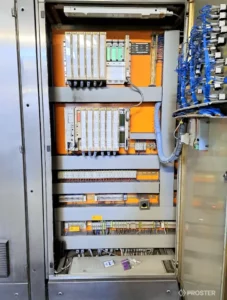
Browar Cieszyn operates a beer filling line for KEG containers that is over 30 years old. The line consists of an external KEG washer, a filling machine, and a CIP/KZE station. The control cabinets were fitted with Simatic S5 controllers, which are no longer supported by the manufacturer in any way.
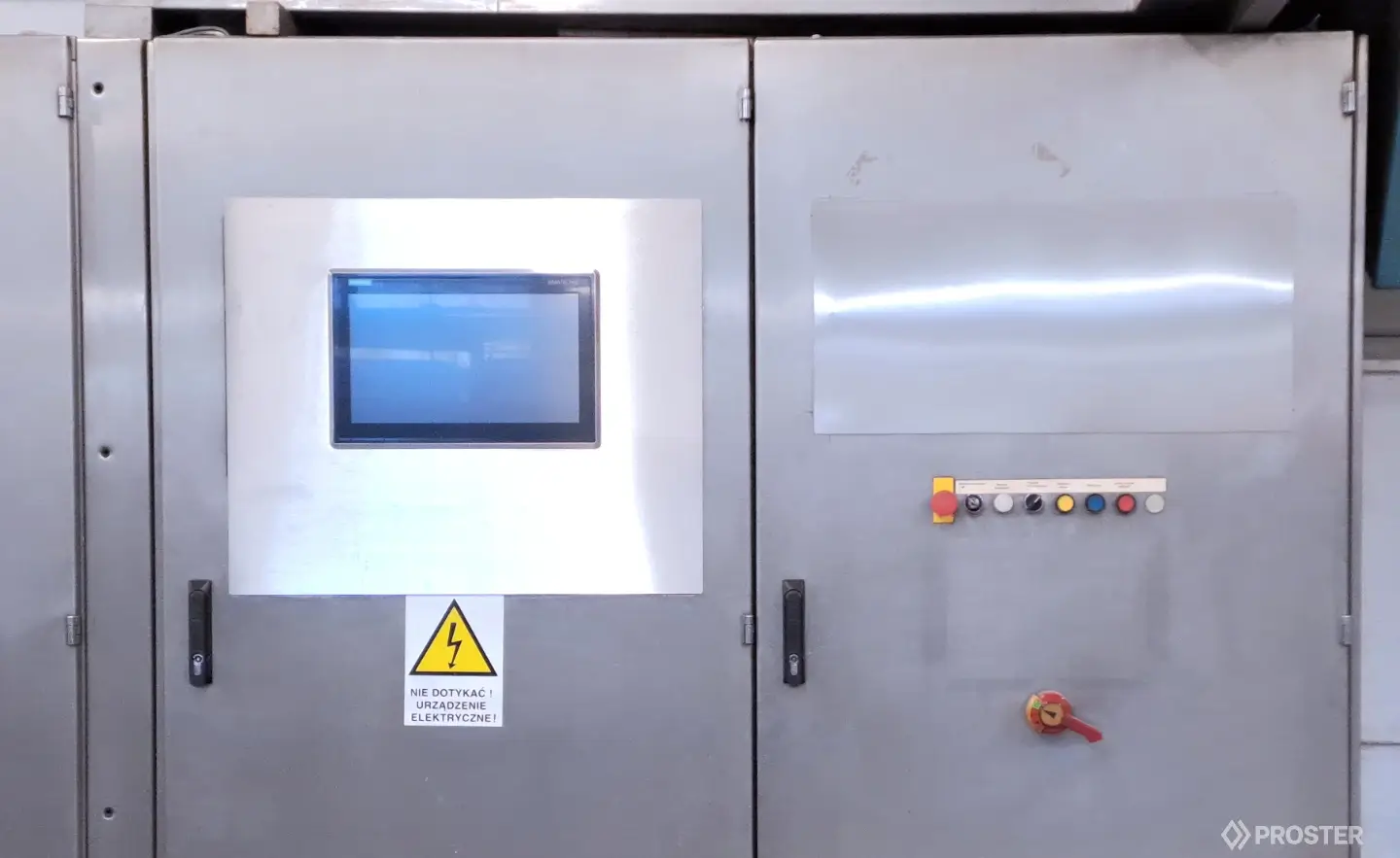
The greatest challenge was the operator panel, whose technical condition left much to be desired — to such an extent that a power failure risked the panel not turning back on.
The deteriorating technical condition of the PLC controllers and HMI panel left the client with no choice but to replace these devices with their modern equivalents.
Condition before modernisation:
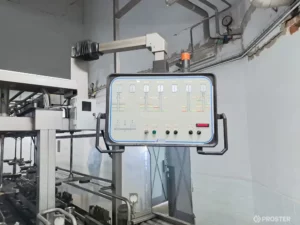
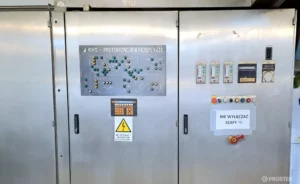
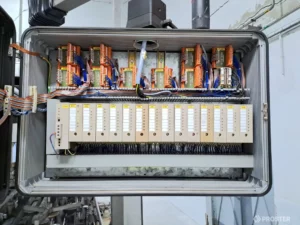
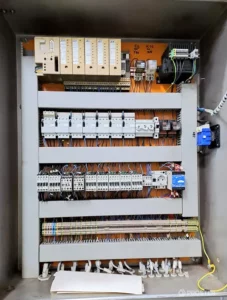
Solution
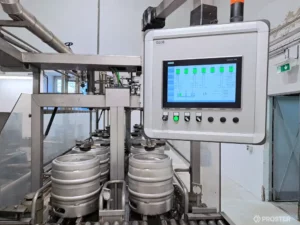
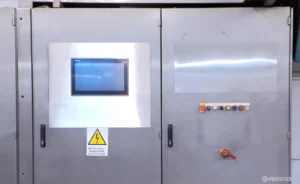
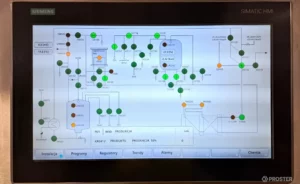
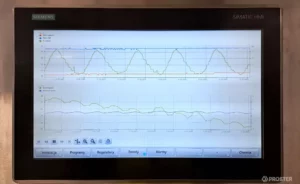
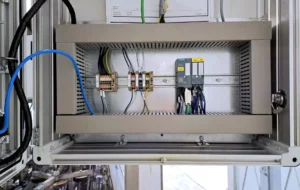
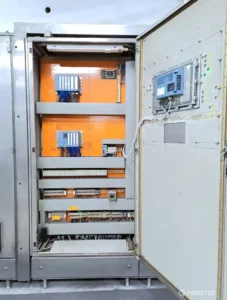
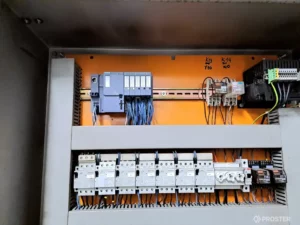
The Simatic S5 controllers were replaced with modern Simatic S7-1500 controllers. The ET100U distributed I/O islands were replaced with ET200SP islands. The synoptic panels were exchanged for Unified Comfort Hygienic MTP1500 panels.
The Siemens SIPART DR20 PID controllers were replaced with their software equivalents (Compact PID controllers from the Siemens library). Similarly, the Dr. Weigert chemical dosing controller and the buffer tank level and pressure controllers were physically removed from the front of the control cabinet, with their functionality replicated within the PLC controller programme.
Condition after modernisation:
How did the project implementation process look?
The migration covered four Simatic S5 controllers along with ET100U islands, one Lauer PCS090 panel, SIPART controllers, and the chemical dosing controller.
The S5 programme migration proceeded in several stages.
- Analysis of the original Simatic S5 controller programmes
The original S5 programmes were first analysed, and those sections that would become entirely redundant in the S7 controller (e.g. blocks for communication with the Lauer panel) were removed.
- Conversion of programmes from S5 to S7-300
The S5 programmes were then converted to S7-300 using Siemens tools. The architecture of S5 controllers differs significantly from that of S7, so after this step all sections of the programme that the conversion tool was unable to handle correctly had to be verified and rewritten.
- Conversion of programmes from S7-300 to S7-1500
Once the programmes compiled without errors in the S7-300 controller environment, the next conversion — from S7-300 to S7-1500 — could begin.
- Rewriting further sections of the programme
It was then necessary to rewrite additional sections of the programme, as not all functions could be compiled correctly under the S7-1500 controller.
- HMI panel visualisations
With the PLC programmes already converted, work could begin on creating the HMI visualisations. This required a further analysis of the programmes and the removal of control signals for the synoptic panels. The process diagrams were recreated from scratch on the Unified Comfort panels. The visualisations were additionally enhanced with functions for logging process variables and displaying them in the form of trends.
- Creation of a PID controller interface
A PID controller interface was also created on the CIP/KZE station panel, replacing the previously removed hardware controllers.
Benefits for the Partner
-
Greater reliability and parts availability
Spare parts for the S5 are becoming increasingly difficult to source and expensive, and due to their age, are frequently unreliable. The S7 controllers are modern and fully supported by Siemens.
-
Better performance and processing speed
S7 controllers have significantly greater computing power, which reduces programme cycle times and improves system performance. This also made it possible to remove the old, dedicated SIPART PID controllers, which had likewise become costly to maintain and unreliable.
-
More effective diagnostics and maintenance
The S7 offers better diagnostic tools, making fault analysis easier and fault resolution faster. The new HMI panels enable the logging of process variables and events, allowing the operation of machines to be monitored and analysed over a broader time horizon.
-
Integration with modern systems
The S5 does not support modern communication protocols, which makes integration with other devices difficult. The S7 will enable the existing machines to be integrated with the SCADA system operating at the plant.
-
Lower operating costs
A reduced risk of failure means shorter downtime and lower maintenance costs.
-
A future-proof solution
S7 to technologia, która będzie rozwijana i wspierana przez wiele lat. To pozwoli na łatwiejszy rozwój i modernizację maszyn w przyszłości.
Talk to an advisor
Send your inquiry and we will talk for a few minutes about your needs.